
TEMPTATION
BY: Richard III
(2025)
Temptation
By: Richard III
Medium: Acrylic on Stretched Canvas
Dimensions: 24in x 48in
Year: 2025
Status: Private Collection / Prints Available
Temptation : Eve
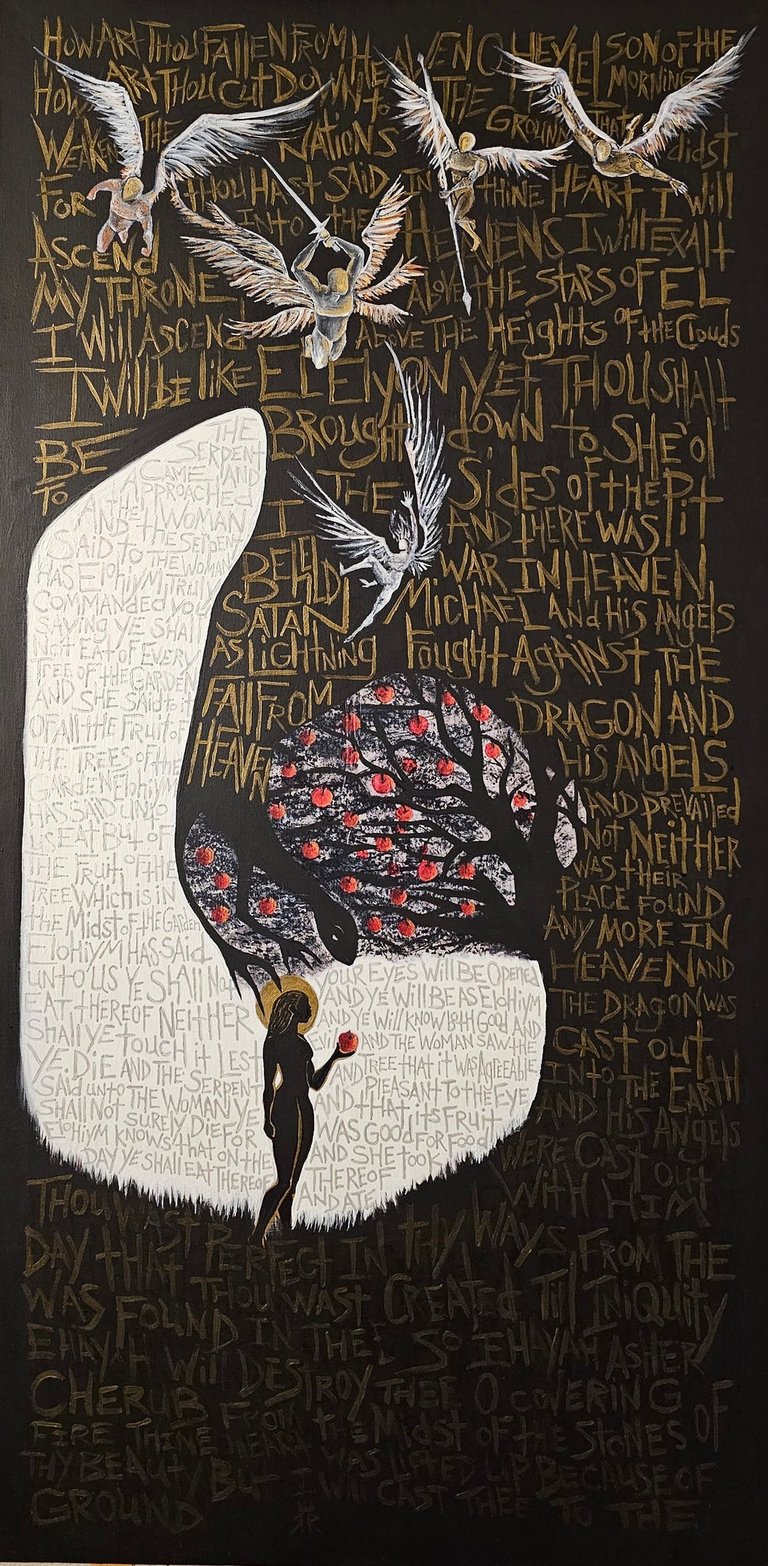
The visual and narrative architecture of Temptation serves as a profound meditation on the archetypal feminine soul, captured in the precise, frozen moment before a choice shifts the tide of human existence. By omitting Adam, the composition isolates the female figure to explore a specific vulnerability: the human woman—our mothers, daughters, sisters, and aunts—standing alone amidst the looming presence of the adversarial. This isolation highlights a universal struggle where the serpent is not merely a conversationalist but a predator that blends seamlessly into the skeletal branches of the tree, becoming an almost invisible part of the environment. The painting utilizes a central organic shape—illustrating the void of space that is the earthly realm—to isolate this struggle from the surrounding cosmic chaos. Within this central space, the silhouetted figure stands in a pool of white light, her head encircled by a golden halo that marks a state of original grace.
The weight of this moment is amplified by a subtle transition occurring just above the scene of the earthly narrative. We see a white silhouette of an angel in the midst of a metamorphosis, his head still turned toward the High Heaven he is being cast out of while his back is cast toward the Earth. In a profound sense of "becoming," this once-luminous figure folds quietly into the dark, predatory silhouette of the serpent, signifying a metamorphosis where what was once light gradually becomes shadow. This "fallen one" becomes the very serpent that drapes over the void, showing the origin of the darkness that now haunts the branches. While the woman stands oblivious to the shadow taking shape just above her, she is entirely indulged in the object of her contemplation, her attention fully surrendered to the allure of the apple.
This apple represents the multifaceted nature of earthly distraction—be it luxury, fame, love, or self-idolatry—acting as a proxy for the internal void the soul seeks to fill. The painting reveals a tragic irony in this pursuit; the woman ignores the inherent divinity and radiance of the Father and the Holy Spirit that already rests upon her head like a crown. Her beauty is not a goal to be attained or a fruit to be consumed; it is a grace she has possessed since the moment of her creation. The narrative suggests that the greatest deception is the pursuit of what one already owns, a distraction designed to make the soul ignore the "High Heaven" it currently inhabits.
Surrounding this scene is a dual framework of text that represents the parallels between two sides of the same coin—a visible representation of "on earth as it is in heaven." While the gold script across the dark canvas documents the cosmic fall in High Heaven, the pearl-colored text etched into the white background records the immediate, earthly temptation. These two narratives exist as mirrors; as the adversary loses his celestial standing in gold, he infiltrates the human narrative in a pearl light. The enemy, having discarded his own beauty out of pride, uses this unfolding story to tempt the woman with a promise of the very grace he rejected. He offers a "fish on a line," attempting to trade her eternal crown for a temporary appetite. Through this interplay of light, shadow, and scripture, the work stands as a warning against the "Unsanctified Mirror," illustrating how the adversary seeks to draw the soul away from grace by convincing us to seek externally for the light that already dwells within.
Original:
$4,750
Studio Embellished Reproduction:
$2,375
Gallery Canvas Reproduction:
$1,280
Fine Art Paper Reproduction:
$475
To ensure the highest quality, all artwork is made on demand at the customer's request. We do not store pre-printed inventory. Please allow time for your custom print to be created. For inquiries or to place an order, please contact info@lazarushousegallery.org or call 702-703-1126. When calling, please leave a detailed message with your inquiry, and we will return your call as promptly as possible.