
ACCUSATION
BY: Richard III
(2025)
Accusation
By: Richard III
Medium: Acrylic on Stretched Canvas
Dimensions: 24in x 48in
Year: 2025
Status: Private Collection / Prints Available
Accusation : Sin of Adam
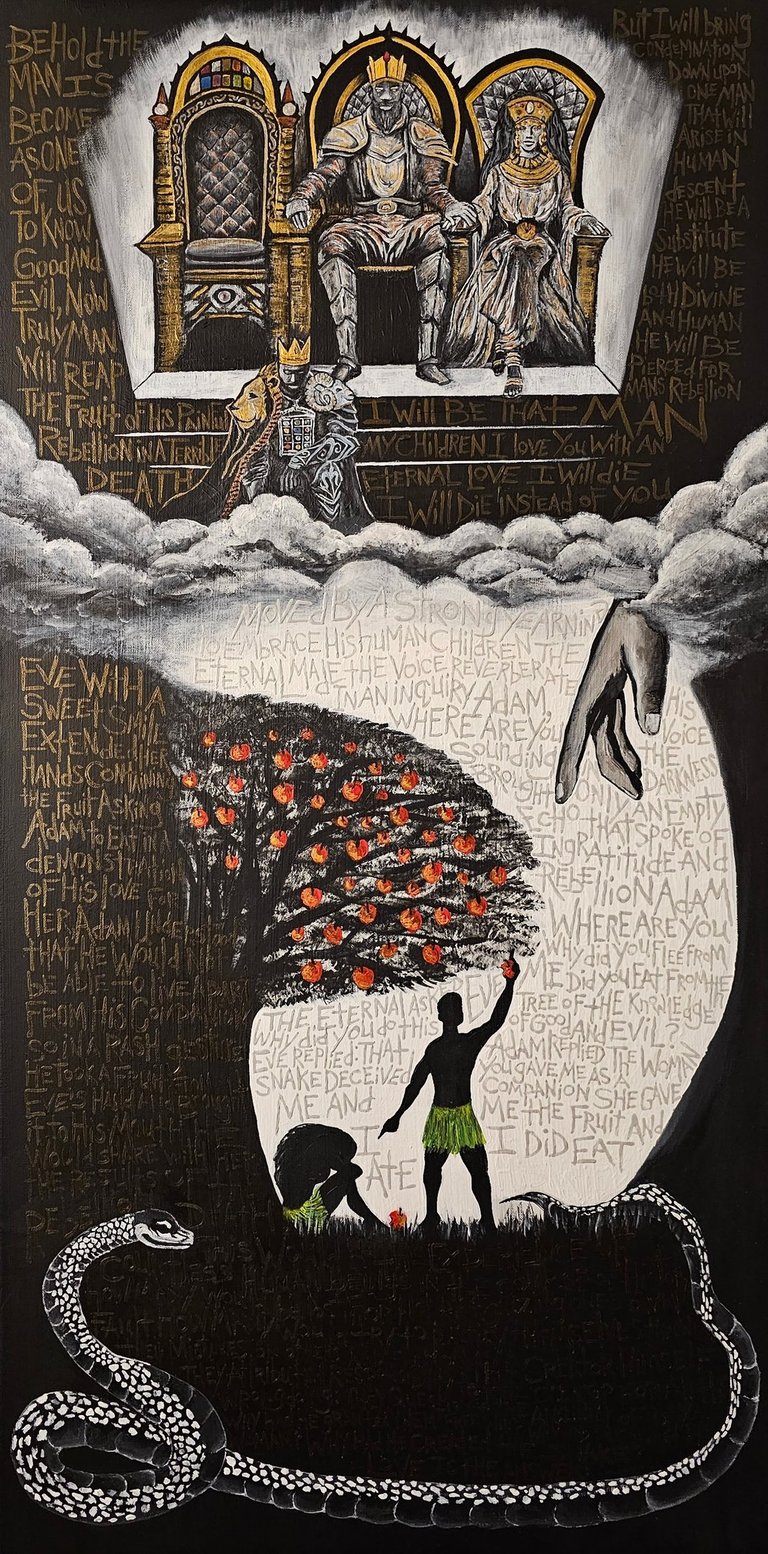
The painting Accusation serves as a profound psychological and spiritual continuation of the earthly narrative, picking up in the immediate wake of the Fall. While traditional depictions of this moment often focus on the shame of nakedness, this work centers on the birth of human defenselessness through the lens of blame. The composition is built on a strict vertical hierarchy, utilizing a "stacked" narrative structure that separates the celestial, the terrestrial, and the subterranean. These three distinct tonal zones move from the golden and pearl-light heights of the divine down into the dense, textured blacks of the earth and the abyss.
This work is designed to function as the second half of a diptych, mirroring the piece Temptation. When hung together, the two paintings form a singular, cohesive narrative with the Tree of Knowledge standing at the center. The left side captures the lure of the temptation of Eve, while the right side—Accusation—reveals the fallout: the shift from curiosity to condemnation.
At the summit of this piece, the imagery is defined by symmetry and regality. The Godhead is depicted as a Royal Family—the Father, the Holy Spirit, and the Son. In a powerful juxtaposition to the discord below, we see the state of High Heaven contrasted against the unsanctified mirror of earth. In the heavens, the King and Queen are seated hand-in-hand, representing the unified, warrior court of the divine in perfect partnership. On the earth below, that mirror is shattered; we see the husband and wife not in union, but in a state of blame, shame, and bitter accusation.
The Christ figure, adorned with the ephod and crown, serves as the bridge between these realms. He extends a hand into the earthly atmosphere—the hand of God entering the narrative not with a fist of fury, but with a gesture of inquisitive love. He seeks a dialogue that man is currently too terrified to embrace. In the terrestrial center, Adam is captured as a dark silhouette, stripped of individual identity to highlight his universal posture: his hand outstretched upward, still clutching the bitten apple, is raised in a sharp point to accuse his Creator. Simultaneously, his other hand is outstretched downward, pointing toward Eve in an act of direct accusation. This reveals a man gripped by self-preservation, using the very gift of the Creator as a shield against accountability.
In the shadow of the tree, the figure of Eve is curled into a tight, circular shape, creating a visual sense of weight and sorrow that contrasts with Adam’s jagged, defensive stance. Her posture illustrates the heavy toll taken on women when men prioritize their own image over their duty to cover and protect. Because Adam chooses to play the victim, Eve is left to shoulder the brunt of the blame in isolation. Her lament is the silent cost of a leadership that has traded love for excuses.
Beneath this human drama, the true adversary has completed his transition. No longer a subtle angelic presence, he is now the serpent in full detail, coiled within a deep, matte blackness. He is a silent observer of the discord he sowed, watching from the depths as the human family fractures. He finds his foothold not just in the initial bite of the fruit, but in the shadows created by our refusal to take responsibility for the choices we make and the people we hurt.
Original:
$4,750
Studio Embellished Reproduction:
$2,375
Gallery Canvas Reproduction:
$1,280
Fine Art Paper Reproduction:
$475
To ensure the highest quality, all artwork is made on demand at the customer's request. We do not store pre-printed inventory. Please allow time for your custom print to be created. For inquiries or to place an order, please contact info@lazarushousegallery.org or call 702-703-1126. When calling, please leave a detailed message with your inquiry, and we will return your call as promptly as possible.